You’ve completed—or you’re about to complete—your Minnesota Permit to Carry course.
Now comes the part that makes some students nervous:
The live-fire shooting qualification.
How far away is the target? How many rounds do you have to shoot? Is it timed? What happens if you miss? Can you use your own handgun? And perhaps the biggest question:
What happens if I don’t pass?
First, relax.
The Minnesota Permit to Carry live-fire qualification is meant to demonstrate safe firearm handling and shooting proficiency. It isn’t designed to trick you, rush you or turn your qualification into a shooting competition.
Let’s walk through what you can expect.
Quick Answer: What Is the Minnesota Permit to Carry Live-Fire Qualification?
Minnesota Permit to Carry training requires successful completion of an actual shooting qualification exercise.
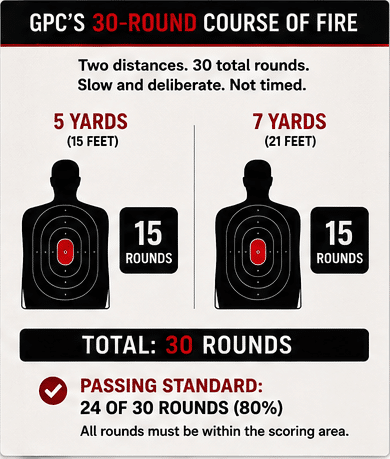
At Gun Permit Center, our live-fire qualification consists of 30 rounds fired from two distances: 15 rounds at 5 yards and 15 rounds at 7 yards. Students must place at least 24 of the 30 rounds within the scoring area to successfully complete the qualification.
The GPC qualification is not timed. We encourage students to shoot slowly and deliberately while demonstrating safe firearm handling and shooting proficiency.
Most importantly, safety begins before the first round is fired.
Is Live Fire Required for a Minnesota Permit to Carry?
Yes.
Minnesota law requires qualifying Permit to Carry training to include:
- Instruction in the fundamentals of pistol use
- Successful completion of an actual shooting qualification exercise
- Instruction in the legal aspects of pistol possession, carry and use, including self-defense and restrictions on the use of deadly force
This applies to qualifying training used for both an original Minnesota Permit to Carry application and a renewal.
That means completing an online Permit to Carry course by itself does not eliminate the live-fire requirement.
If you choose an online training program, make sure you understand where and how you’ll complete the required shooting portion.
How Many Rounds Do You Shoot?
This is an area where it’s important to distinguish between Minnesota requirements and an individual training organization’s course of fire.
Minnesota’s Department of Public Safety requires approved training organizations to use a live-fire qualification consisting of at least 25 rounds fired at multiple distances.
Individual approved training organizations can establish their own qualifying course of fire within those requirements.
Gun Permit Center’s Live-Fire Qualification
GPC’s current course of fire consists of:
5 yards (15 feet): 15 rounds
7 yards (21 feet): 15 rounds
Total: 30 rounds
Passing proficiency: 24 of 30 rounds within the scoring area (80%)
Both portions are completed using slow, deliberate, two-handed shooting.
These are Gun Permit Center’s qualification standards and should not be interpreted as the required course of fire used by every Minnesota Permit to Carry training provider.
Are 5 and 7 Yards Far Away?
When someone hears 15 feet and 21 feet, those distances can sound intimidating—especially to a newer shooter.
We hear it all the time.
One of the first things we tell nervous students is that the range is a controlled environment and the distances usually look considerably closer once you’re actually standing on the firing line looking at the target.
Don’t let the numbers get in your head before you even arrive.
At GPC, the qualification isn’t timed.
Slow down. Get your grip. Find your sights. Take a breath. Make a deliberate shot.
You aren’t racing the person in the next lane.
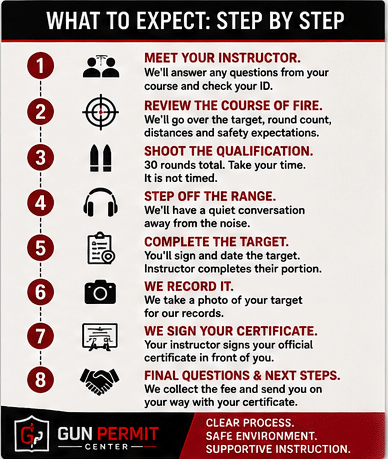
What Happens When I Meet My GPC Instructor?
We don’t want you walking onto the range wondering what’s about to happen.
Your instructor will typically begin by checking your identification and asking whether you have any questions from the course material that you’d like clarified.
Then we’ll show you the actual target you’ll be using.
Before firing, we’ll explain:
- The course of fire
- Number of rounds
- Shooting distances
- Passing standard
- Range and safety expectations
- What will happen after you finish shooting
By the time you step onto the firing line, you should understand what you’re being asked to do.
There shouldn’t be a mystery.

Firearm Safety Comes FIRST – Always Maintain The 4 Fundamental Firearm Safety Rules.
Safety Comes Before Your Score
Your score matters.
Your firearm handling matters more.
We operate qualifications at ranges with their own safety requirements, and GPC instructors are expected to take unsafe firearm handling seriously.
Muzzle discipline, trigger-finger discipline and following range commands aren’t optional.
If an unsafe act occurs, the instructor will intervene immediately.
Depending on the circumstances, one unsafe act may end the qualification for the day.
That’s not about being unnecessarily harsh.
Our instructors have an obligation to protect the student, themselves, everyone else using the range and the relationships we’ve built with the facilities that allow us to conduct training there.
More importantly, ignoring unsafe behavior would effectively condone it.
A Permit to Carry qualification is supposed to demonstrate safe firearm handling. We can’t overlook unsafe firearm handling simply because someone’s score is good.
Is the Shooting Qualification a Lesson?
Not exactly.
This distinction is important.
The live-fire qualification is intended to demonstrate your individual proficiency.
It shouldn’t become a situation where an instructor stands behind you and coaches you through every shot until you produce a passing score.
Our instructors are generally instructed not to interrupt a shooter to give constant shooting pointers during the qualification. An unsafe act is different—that requires immediate intervention.
However, we’re also instructors.
We don’t want to simply stand behind someone, keep score and send them home.
After firing a few rounds, a student can stop and ask the instructor for some feedback. We may identify one or two small things worth considering.
Sometimes a small adjustment makes a significant difference.
But there’s a difference between a quick observation and turning the qualification into a full private shooting lesson.
If more instruction is needed, we’d rather slow things down and schedule dedicated one-on-one training.
What Are Instructors Looking For?
Passing isn’t simply about punching holes in paper.
Your instructor is evaluating several things.
Safe firearm handling
This starts before you fire your first round.
We’re paying attention to how you handle the firearm and your overall attitude toward safety.
Do you respect the firearm and what it’s capable of?
Shooting proficiency
Minnesota requires successful completion of a shooting qualification. Your target provides an objective measure of that proficiency.
Consistency
We’re also watching the fundamentals.
Two of the areas we commonly pay attention to are grip and sight alignment.
We’re not looking for competition-level shooting.
We’re looking for someone who can safely and consistently operate the firearm and demonstrate the proficiency required to complete the qualification.
What Are Some Common Problems?
Two of the biggest issues we see are:
Poor grip
and
recoil anticipation.
Recoil anticipation can cause a shooter to push, dip or otherwise move the handgun immediately before the shot breaks.
Sometimes the solution isn’t firing faster or trying harder.
It’s exactly the opposite.
Slow down.
Remember, the GPC qualification isn’t timed.
What If I’m a Brand-New Shooter?
Tell us.
Seriously.
There’s nothing embarrassing about being new to firearms.
We would much rather know your experience level before walking onto the range.
Sometimes a newer shooter simply needs a few minutes to become comfortable with the environment and understand what’s happening.
Other times, someone would benefit from dedicated beginner or one-on-one handgun instruction before attempting—or reattempting—the qualification.
A Permit to Carry qualification isn’t intended to replace comprehensive beginner firearms training.
And there’s absolutely nothing wrong with deciding you want more training.
What Should I Bring to the Range?
If you have your own equipment, we generally recommend bringing it.
That may include:
- Your handgun
- Appropriate ammunition
- Eye protection
- Hearing protection
Bring valid identification. GPC instructors verify ID.
If you don’t own all of the necessary equipment, don’t automatically assume that prevents you from completing the qualification.
Many of the ranges our instructors use have firearms available for rental and may have eye and hearing protection available.
Some GPC instructors may also allow students to use an instructor-provided firearm. Policies and fees vary by instructor and location.
Talk with your instructor beforehand so you know exactly what you’ll need.
Can I Use My Own Handgun?
Absolutely.
In fact, if you already own a handgun and are comfortable using it, bringing your own firearm and ammunition is generally encouraged.
You’re demonstrating your proficiency, so using equipment you’re familiar with often makes sense.
If you don’t own a firearm, contact your instructor. Rental and instructor-provided options may be available depending on the location.


What Happens If I Don’t Pass?
First:
Not passing a qualification doesn’t mean you’re done forever.
At GPC, we generally use a 24-hour rule before a student makes another qualification attempt.
Why?
Because simply handing someone another magazine and immediately repeating the same thing isn’t necessarily going to produce a different result.
Use the time productively.
Go practice.
Work on the fundamentals.
Or schedule a private one-on-one session with one of our instructors.
Policies regarding additional qualification fees vary by instructor. Some instructors may include one additional attempt while others charge a minimal fee for a return qualification.
If there’s a second unsuccessful attempt, additional training is probably the better investment.
The goal isn’t to keep charging someone to repeatedly attempt a test.
The goal is to help develop a safer, more confident and more proficient shooter.
What Happens After I Pass?
Once the shooting portion is complete, we generally pack up and step away from the firing line.
There’s a practical reason:
It’s much easier to have a conversation without competing with gunfire while wearing hearing protection.
The student completes the acknowledgment portion of the qualification target, including the required identifying information, signature and date.
The instructor completes their portion of the target as well.
We then photograph the completed target for GPC’s training records.
Your instructor will complete and sign your official training certificate in front of you.
That’s also a good time for final questions.
We don’t want you walking out the door wondering what you’re supposed to do next.
Once everything is completed, the instructor collects the applicable qualification fee and you’ll leave with your training documentation.
What Do I Do With My Certificate?
Your training certificate is evidence that you’ve completed the qualifying training required for your Minnesota Permit to Carry application.
Minnesota law requires the certified instructor to issue a signed certificate to someone who successfully completes the required training.
Minnesota residents generally submit their Permit to Carry application through the sheriff’s office in the county where they reside.
Remember that qualifying training must have been completed within one year of your original or renewal application.
Don’t complete the training and then forget about the application for more than a year.
Do Renewal Students Have to Complete Live Fire Again?
Yes.
Minnesota requires evidence of qualifying training within one year of an original or renewal Permit to Carry application.
That qualifying training includes successful completion of an actual shooting qualification.
Having successfully completed the shooting portion when you originally obtained your permit doesn’t eliminate the training requirement when it’s time to renew.
Is the Minnesota Permit to Carry Shooting Test Hard?
We don’t think the qualification should be designed to create a high failure rate.
But it also needs to mean something.
The purpose is to demonstrate proficiency and safe firearm handling.
There’s a balance.
We’re not looking for bullseye competition shooters.
We’re also not interested in treating live fire as a formality where everyone automatically passes simply for showing up.
Your certificate should represent something.
You completed the required education.
You demonstrated safe firearm handling.
You demonstrated shooting proficiency.
You earned it.
Frequently Asked Questions About the Minnesota Permit to Carry Shooting Qualification
Is the GPC live-fire qualification timed?
No. Gun Permit Center’s qualification is not timed. Students are encouraged to shoot slowly and deliberately.
How many rounds does GPC require?
GPC’s current qualification uses 30 rounds: 15 rounds at 5 yards and 15 rounds at 7 yards.
What score do I need to pass the GPC qualification?
Students must place at least 24 of 30 rounds within the designated scoring area, an 80% proficiency standard.
Can I take my Minnesota Permit to Carry course online and skip the shooting portion?
No. Minnesota qualifying training includes successful completion of an actual shooting qualification. An online educational course does not eliminate that requirement.
Can I use my own handgun?
Yes. Students who have their own firearm and ammunition are generally encouraged to use their own equipment.
What if I don’t own a handgun?
Contact your instructor. Many ranges offer rental firearms, and some instructors may have firearms available for student use. Availability and fees vary.
What happens if I fail?
GPC generally requires at least 24 hours before another attempt. We encourage students to use that time to practice or consider individual instruction. Requalification fees vary by instructor.
Can my instructor coach me during the qualification?
The qualification needs to demonstrate the student’s own proficiency, so instructors generally don’t provide continuous coaching. Students may pause and ask for limited feedback, but extensive instruction should occur separately from the qualification.
Can unsafe firearm handling cause me to fail?
Yes. Safety is part of demonstrating proficiency. An instructor will immediately intervene when unsafe firearm handling occurs, and depending on the circumstances, an unsafe act may end the qualification for the day.
Do I have to shoot again when renewing my Minnesota Permit to Carry?
Yes. Qualifying training for a renewal also includes successful completion of an actual shooting qualification.
More Than a Certificate
Completing your Minnesota Permit to Carry qualification shouldn’t feel like checking a box.
We want students to leave with a sense of accomplishment and a sense of pride in the fact that they invested in their own safety and confidence.
Passing the qualification isn’t the end of your firearms education.
Keep shooting.
Keep practicing.
Keep learning.
And if you need someone to shoot with, give us a call.
Ready to Complete Your Minnesota Permit to Carry Training?
Gun Permit Center offers a self-paced online Minnesota Permit to Carry course followed by an in-person live-fire qualification with one of our preferred instructors.
Whether you’re applying for your first Minnesota Permit to Carry or renewing an existing permit, we’ll help make the training and qualification process straightforward.
Awareness. Protection. Empowerment.
This article is provided for general educational purposes and is not legal advice. Minnesota firearm laws, administrative requirements and individual instructor/range policies can change. Always verify current legal requirements with the Minnesota Bureau of Criminal Apprehension/Department of Public Safety and confirm qualification details with your instructor.