
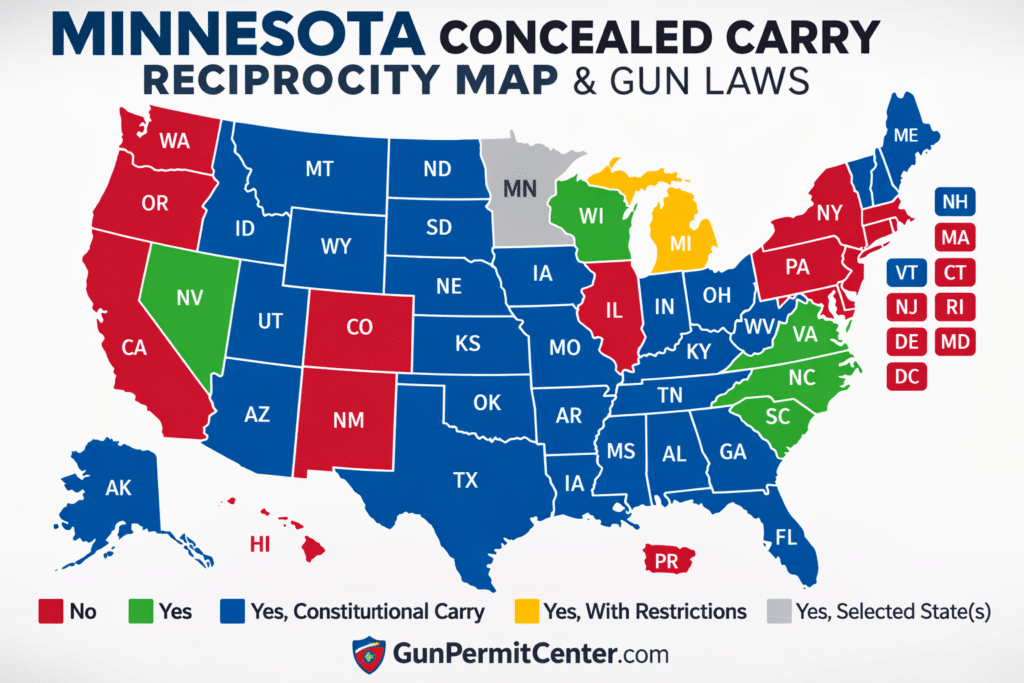
Most people think getting their Minnesota Permit to Carry means they’re set anywhere they travel.
Not quite.
Every state has its own laws, its own rules, and its own standards for recognizing permits from other states. That means a permit that’s perfectly valid in Minnesota might not mean the same thing once you cross a state line.
We get questions about this all the time from students:
“Can I carry when I drive through Wisconsin?”
“What about Florida on vacation?”
“Does my Minnesota permit work in Texas?”
The answer depends on reciprocity — and understanding how it works is part of carrying responsibly.
So let’s break it down.
What Reciprocity Means (And Why It Matters)
Reciprocity is the legal recognition of one state’s carry permit by another state.
For Minnesota residents, reciprocity decisions fall under Minnesota Statute 624.714, which requires the Minnesota Department of Public Safety to review other states’ permit laws annually.
When evaluating another state’s permit system, Minnesota looks at factors such as:
- Minimum age requirements
- Background check standards
- Training requirements
- Permit issuance processes
If another state’s laws are considered substantially similar, Minnesota may recognize that permit.
Other states perform the same type of evaluation when deciding whether to recognize a Minnesota Permit to Carry.
Recent federal court rulings between 2023–2025 also affected reciprocity by striking down Minnesota’s previous 21-year-old minimum age requirement, bringing Minnesota more in line with many other states.
If you’re still working through the process of getting your permit, our Minnesota Permit to Carry course walks through the legal requirements, safe carry practices, and reciprocity basics step-by-step.